Biome.ai

An embodied use of mediatechture or media and architecture for wellness. Exploring of AI and its situatedness in a library space.

Biome.ai

An embodied use of mediatechture or media and architecture for wellness. Exploring of AI and its situatedness in a library space.

Biome.ai

An embodied use of mediatechture or media and architecture for wellness. Exploring of AI and its situatedness in a library space.

Interactive Environments

Interaction Design

Prototyping

Embodied AI

Interactive Environments

Interaction Design

Prototyping

Embodied AI

Interactive Environments

Interaction Design

Prototyping

Embodied AI

Role

Design Research, Prototyping, Art Direction

Tools

P5.js, Projectors

Timeline

Jan - May 2023 (4 Months)

Methods

Rapid Prototyping, Testing

Team

Daniel Tsiu, Aishwarya Lande

Role

Design Research, Prototyping, Art Direction

Tools

P5.js, Projectors

Timeline

Jan - May 2023 (4 Months)

Methods

Rapid Prototyping, Testing

Team

Daniel Tsiu, Aishwarya Lande

Role

Design Research, Prototyping, Art Direction

Methods

Rapid Prototyping, Testing

Tools

P5.js, Projectors

Team

Daniel Tsiu, Aishwarya Lande

Jan - May 2023 (4 Months)

Timeline

Overview

Biome AI is an interactive spatial computing project designed for the Georgia Tech Library. The project transforms the Crosland Library stairs—a transient, high-traffic area—into a "Digital Biome" that promotes mental wellness. By utilizing computer vision and generative projection mapping, the installation creates a responsive environment that reacts to students' presence with calming, nature-inspired visuals, turning a mundane architectural feature into a site for autogenic relaxation.

Overview

Biome AI is an interactive spatial computing project designed for the Georgia Tech Library. The project transforms the Crosland Library stairs—a transient, high-traffic area—into a "Digital Biome" that promotes mental wellness. By utilizing computer vision and generative projection mapping, the installation creates a responsive environment that reacts to students' presence with calming, nature-inspired visuals, turning a mundane architectural feature into a site for autogenic relaxation.

Overview

Biome AI is an interactive spatial computing project designed for the Georgia Tech Library. The project transforms the Crosland Library stairs—a transient, high-traffic area—into a "Digital Biome" that promotes mental wellness. By utilizing computer vision and generative projection mapping, the installation creates a responsive environment that reacts to students' presence with calming, nature-inspired visuals, turning a mundane architectural feature into a site for autogenic relaxation.

Problem

The Georgia Tech Library hosts a massive student population often under high academic stress. While the library offers study spaces, it lacked "passive" restoration zones where students could decompress without actively engaging in a task.

The Prompt: Explore interactive media environments for the library stairs to fascinate, relax, or inspire passersby.

The Core Problem: How might we utilize the transitional space of a staircase to interrupt the cycle of stress and provide a moment of unsolicited relaxation?

Problem

The Georgia Tech Library hosts a massive student population often under high academic stress. While the library offers study spaces, it lacked "passive" restoration zones where students could decompress without actively engaging in a task.

The Prompt: Explore interactive media environments for the library stairs to fascinate, relax, or inspire passersby.

The Core Problem: How might we utilize the transitional space of a staircase to interrupt the cycle of stress and provide a moment of unsolicited relaxation?

Problem

The Georgia Tech Library hosts a massive student population often under high academic stress. While the library offers study spaces, it lacked "passive" restoration zones where students could decompress without actively engaging in a task.

The Prompt: Explore interactive media environments for the library stairs to fascinate, relax, or inspire passersby.

The Core Problem: How might we utilize the transitional space of a staircase to interrupt the cycle of stress and provide a moment of unsolicited relaxation?

Opportunity Statement

The design process began with a divergent exploration phase, generating seven unique "Opportunity Statements" ranging from gamified group play to career inspiration stories.

We utilized a matrix of impact vs. feasibility to narrow our focus. We selected the Relaxation typology, defined by the following opportunity statement:

"As part of our efforts to make students feel relaxed, the Student Wellness Center will provide a moment of relaxation at the Crosland Library Stairs by having a flower bloom in real-time behind them as they sit & study."
Opportunity Statement

The design process began with a divergent exploration phase, generating seven unique "Opportunity Statements" ranging from gamified group play to career inspiration stories.

We utilized a matrix of impact vs. feasibility to narrow our focus. We selected the Relaxation typology, defined by the following opportunity statement:

"As part of our efforts to make students feel relaxed, the Student Wellness Center will provide a moment of relaxation at the Crosland Library Stairs by having a flower bloom in real-time behind them as they sit & study."

Opportunity Statement

The design process began with a divergent exploration phase, generating seven unique "Opportunity Statements" ranging from gamified group play to career inspiration stories.

We utilized a matrix of impact vs. feasibility to narrow our focus. We selected the Relaxation typology, defined by the following opportunity statement:

"As part of our efforts to make students feel relaxed, the Student Wellness Center will provide a moment of relaxation at the Crosland Library Stairs by having a flower bloom in real-time behind them as they sit & study."

Site - The Stairs

Site - The Stairs

Site - The Stairs

Site Analysis:
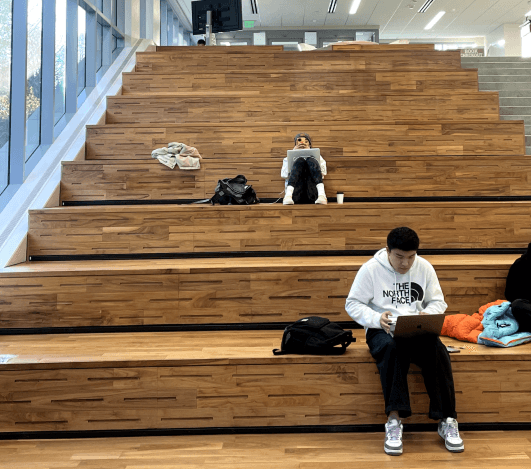
Site: Crosland Library Stairs. Affordances: Quiet, communal, physically tiered (ideal for distinct "zones").

Constraints: Content must be subtle and non-distracting to nearby studying students.
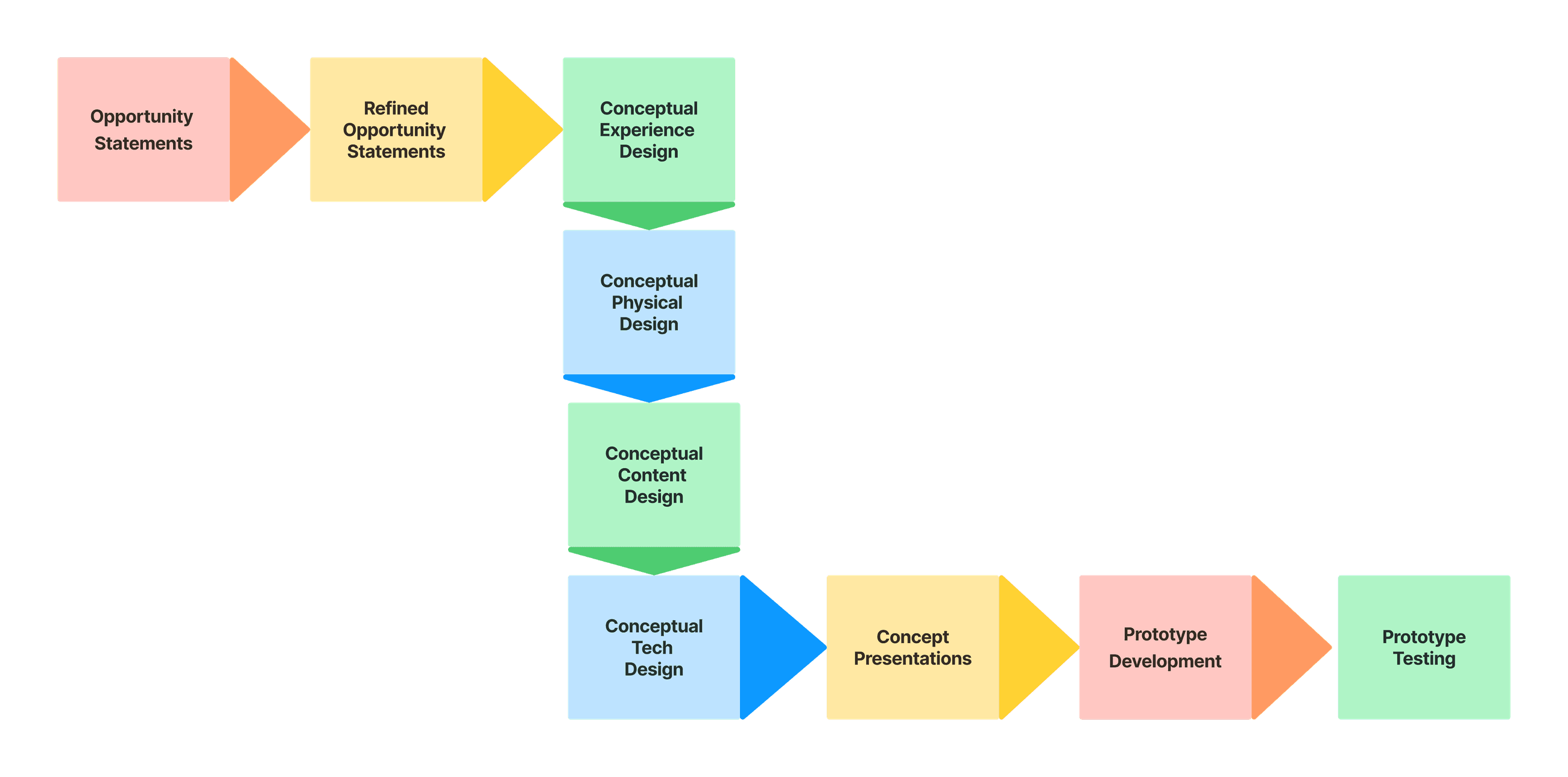
The flow of processes we followed
The flow of processes we followed

The flow of processes we followed

Concept
  1. Conceptual Experience Design

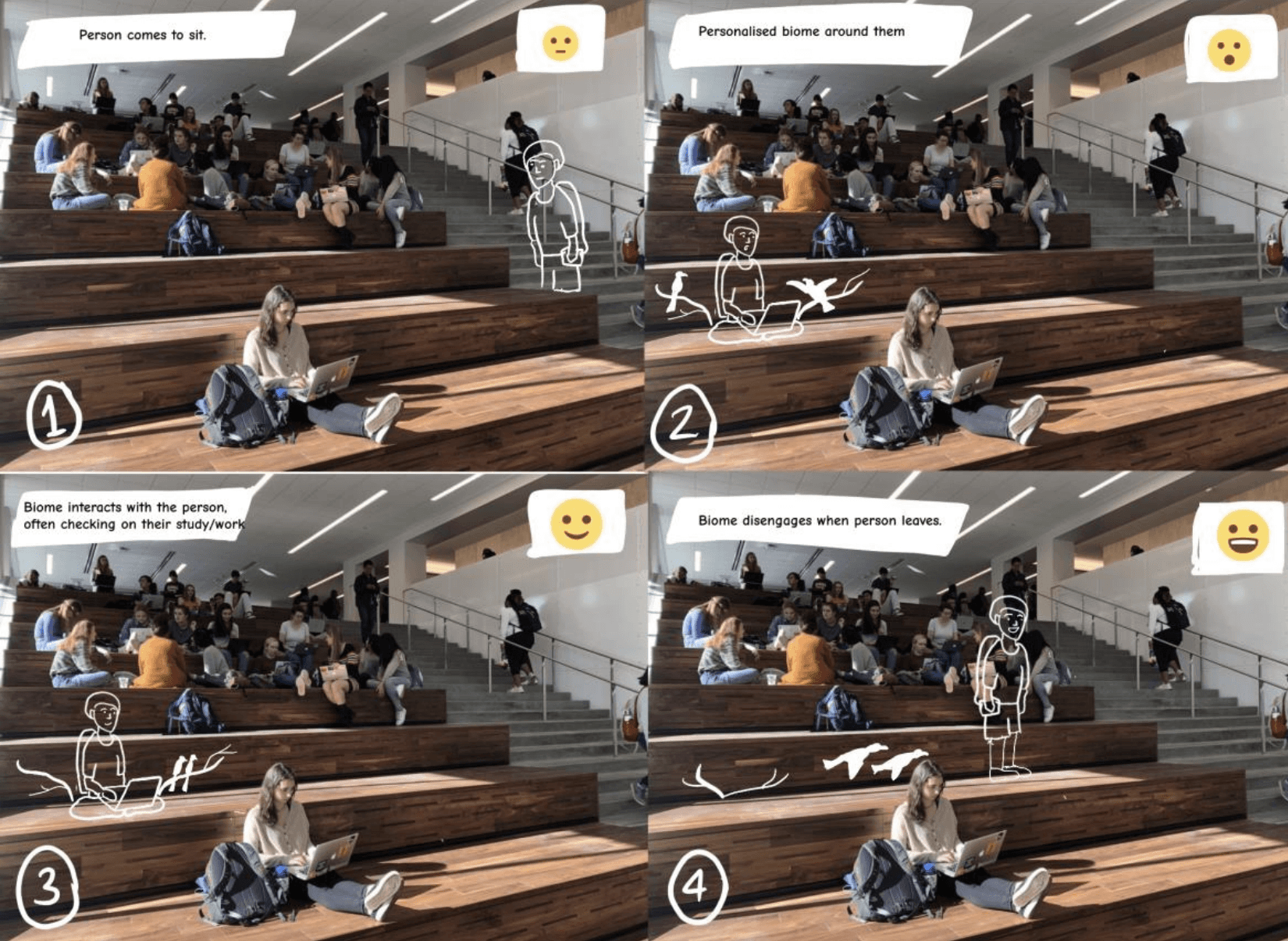
The core interaction model relies on passive companionship. When a student sits on a step, the system detects their presence and generates a digital habitat around them. This creates a "Simulated Vivarium" where digital creatures interact not only with the physical architecture but also with the student.


Concept
  1. Conceptual Experience Design

The core interaction model relies on passive companionship. When a student sits on a step, the system detects their presence and generates a digital habitat around them. This creates a "Simulated Vivarium" where digital creatures interact not only with the physical architecture but also with the student.


Concept
  1. Conceptual Experience Design

The core interaction model relies on passive companionship. When a student sits on a step, the system detects their presence and generates a digital habitat around them. This creates a "Simulated Vivarium" where digital creatures interact not only with the physical architecture but also with the student.


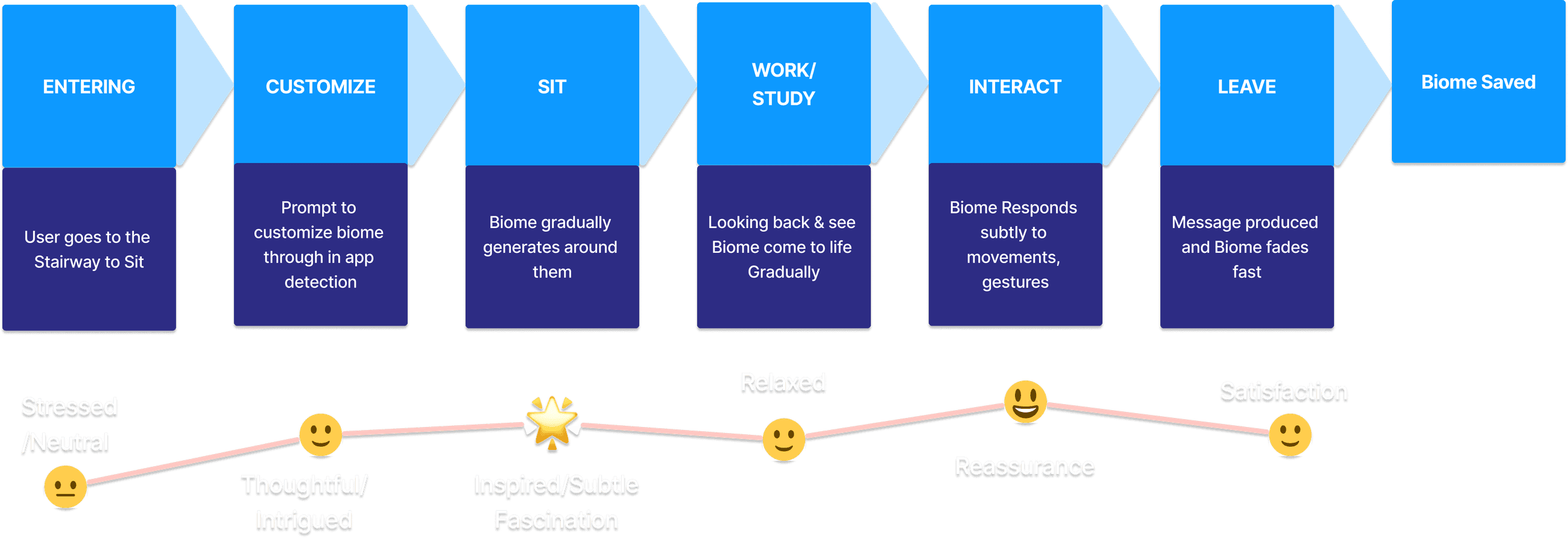
Mapping out how the journey could look like at the site

Mapping out how the journey could look like at the site

Mapping out how the journey could look like at the site

The Experience Pillars:

Autogenic Relaxation: Using visual imagery (nature scenes) to trigger a relaxation response.

Guided Imagery: distinct habitats (e.g., underwater, forest) that transport the user away from the academic setting.

Responsive Ecology: Creatures have encoded behaviors (reaction to other animals, reaction to the biome, reaction to the human creator).

  1. Concept Physical Design

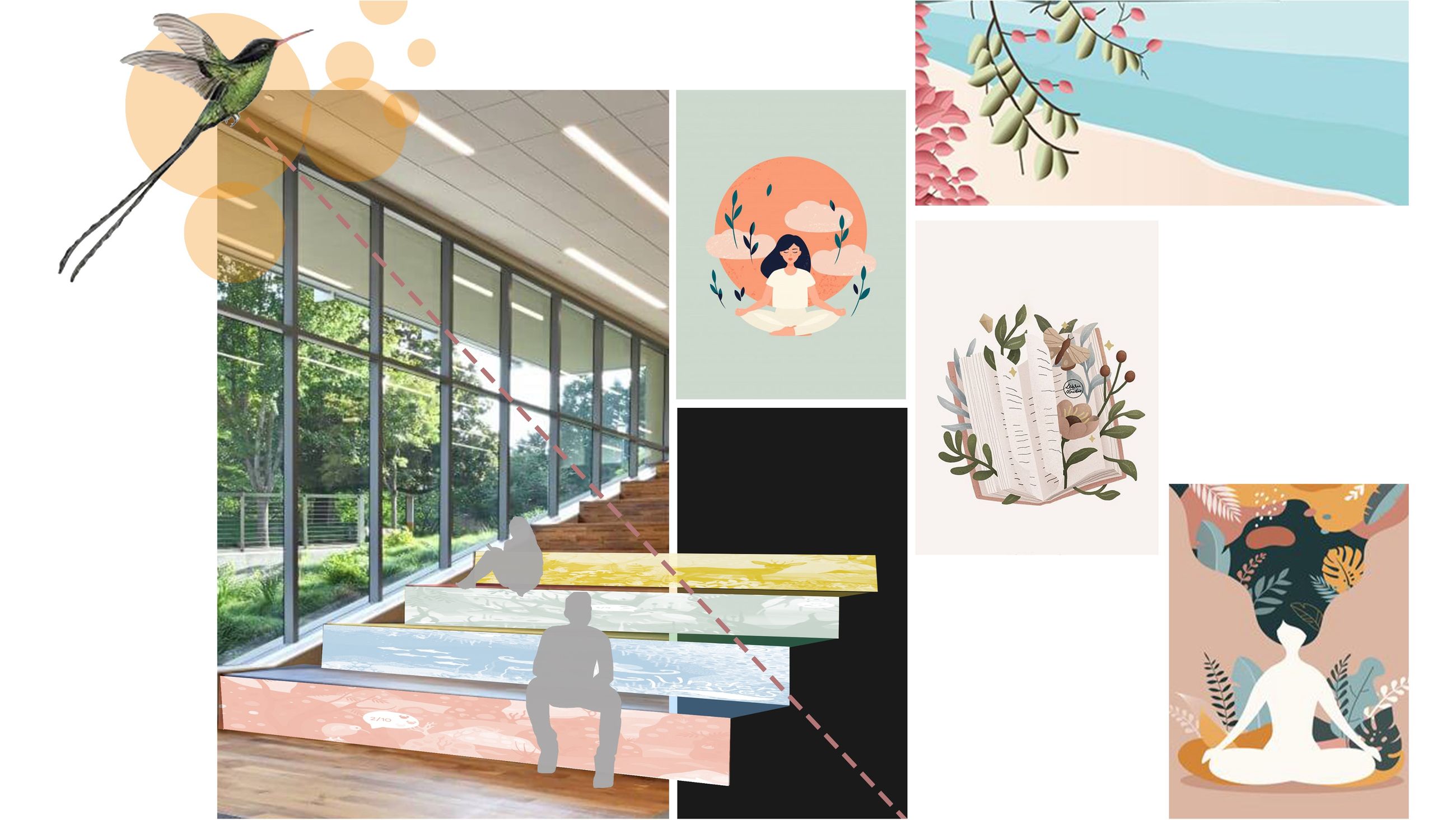
Sketching how human sitting would work in a functioning stair space ona given day

Sketching how human sitting would work in a functioning stair space ona given day

Sketching how human sitting would work in a functioning stair space ona given day

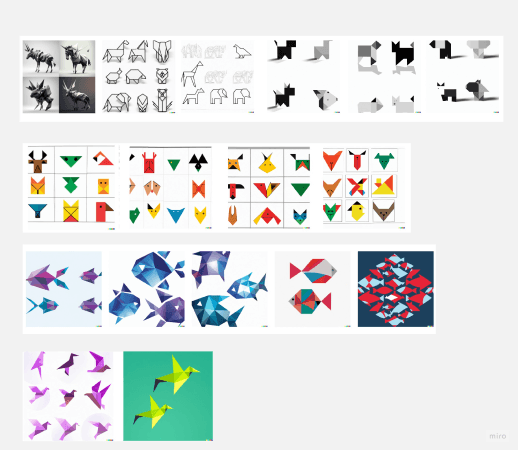
3. Conceptual Content Design
Autogenic Relaxation
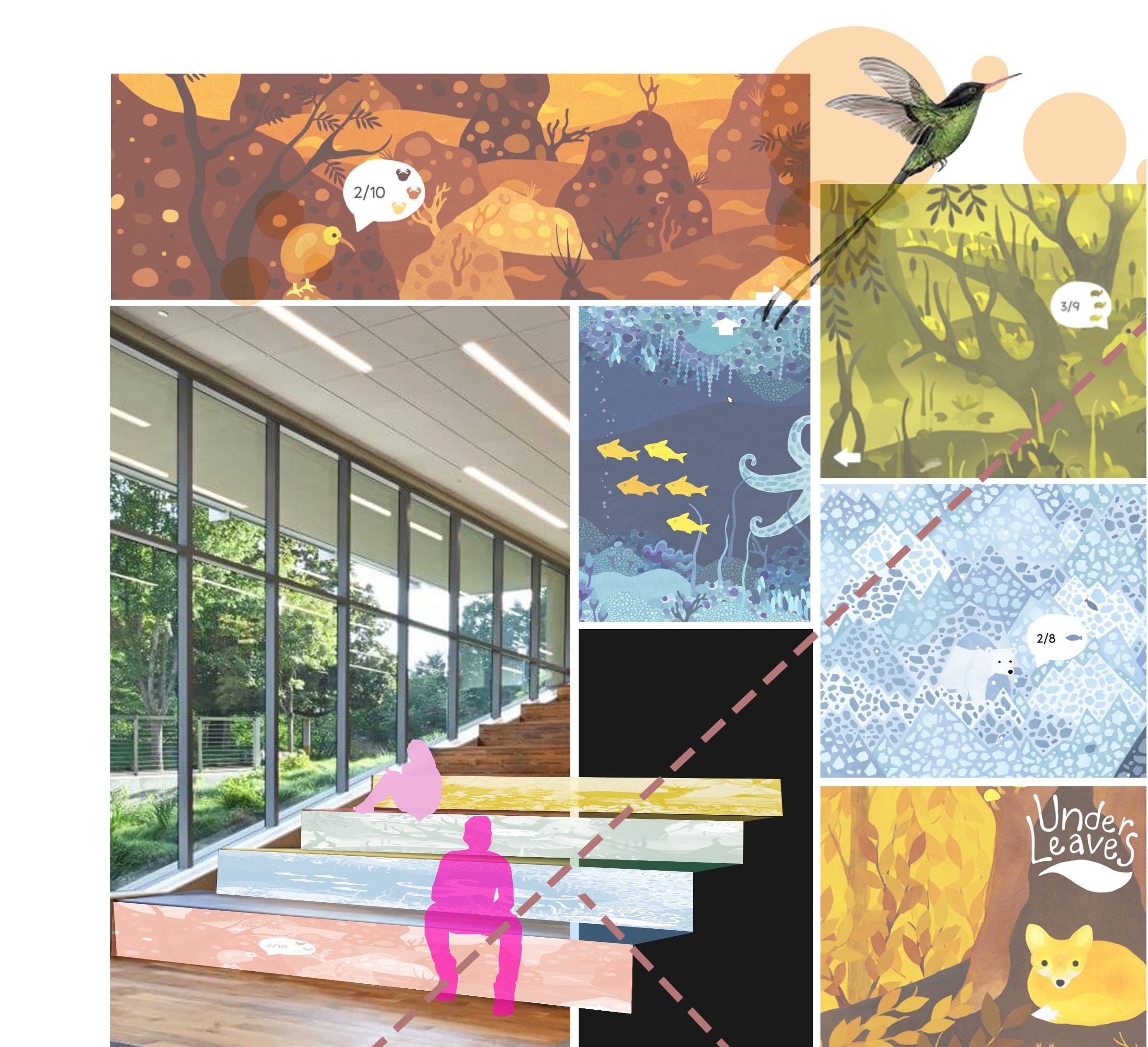
Autogenic Relaxation

Guided Imagery
Guided Imagery

Responsive Ecology

Responsive Ecology

Autogenic Relaxation

Guided Imagery

Responsive Ecology
Design

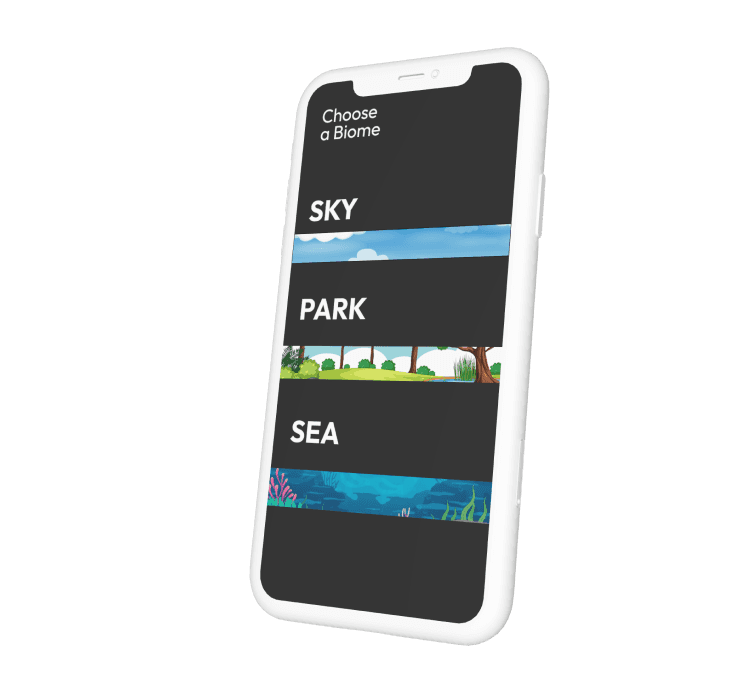
While the installation is the primary output, we designed a mobile companion interface to allow for personalization, giving students agency over their environment.

The User Journey:

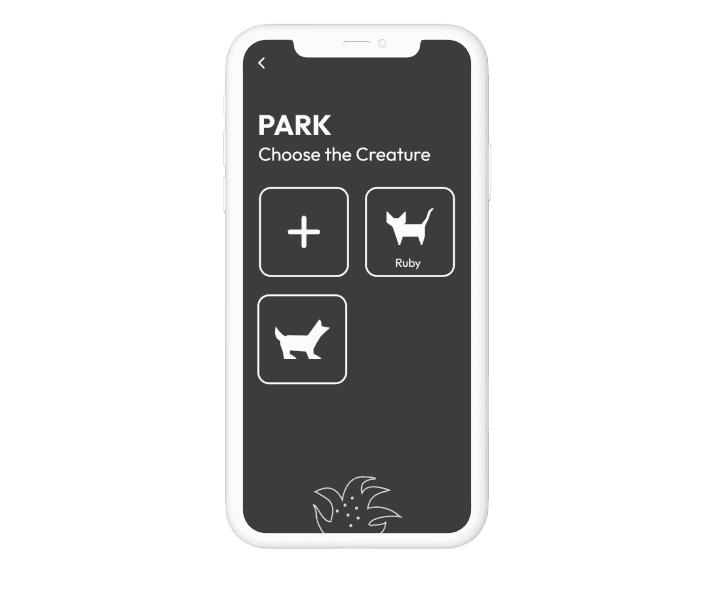
  1. Selection: The student accesses the "Creator App" on their phone.

  2. Biome Choice: Selects a habitat (e.g., Park, Ocean).

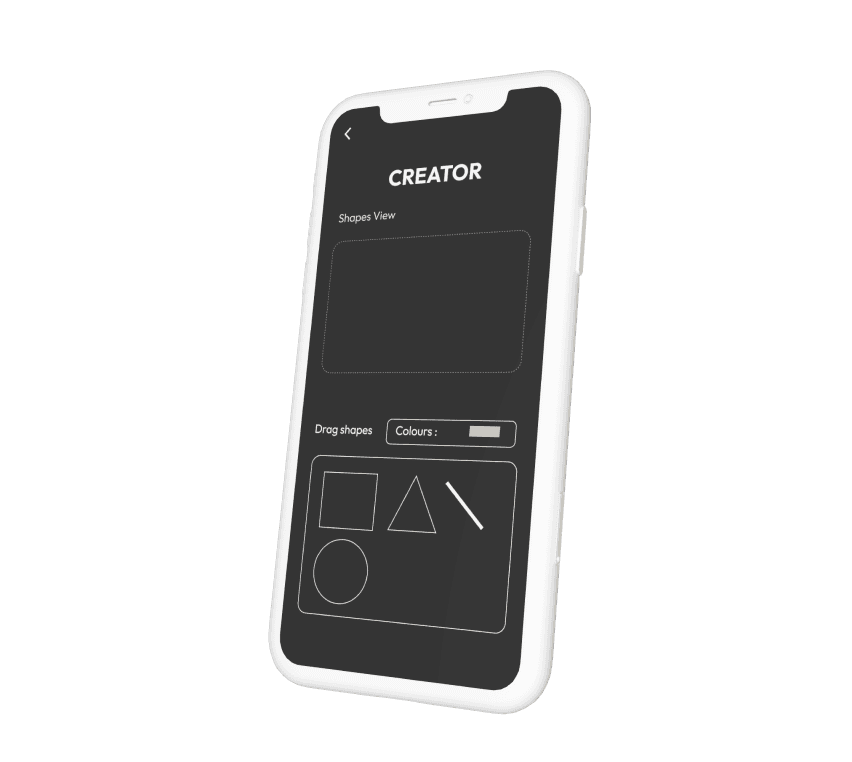
  3. Creation: Users can launch pre-made creatures or use abstract shapes to "sculpt" a unique companion.

  4. Deployment: The creature is "launched" from the phone onto the stairs, joining the generative ecosystem.


Design

While the installation is the primary output, we designed a mobile companion interface to allow for personalization, giving students agency over their environment.

The User Journey:

  1. Selection: The student accesses the "Creator App" on their phone.

  2. Biome Choice: Selects a habitat (e.g., Park, Ocean).

  3. Creation: Users can launch pre-made creatures or use abstract shapes to "sculpt" a unique companion.

  4. Deployment: The creature is "launched" from the phone onto the stairs, joining the generative ecosystem.


Design

While the installation is the primary output, we designed a mobile companion interface to allow for personalization, giving students agency over their environment.

The User Journey:

  1. Selection: The student accesses the "Creator App" on their phone.

  2. Biome Choice: Selects a habitat (e.g., Park, Ocean).

  3. Creation: Users can launch pre-made creatures or use abstract shapes to "sculpt" a unique companion.

  4. Deployment: The creature is "launched" from the phone onto the stairs, joining the generative ecosystem.


Home Screen

Adding Creature

Creature Builder through Shapes

Home Screen

Adding Creature

Creature Builder through Shapes

Home Screen

Adding Creature

Creature Builder through Shapes

Prototyping

The development followed a rapid iterative cycle using P5.js for visual generation and physical prototyping for spatial testing.
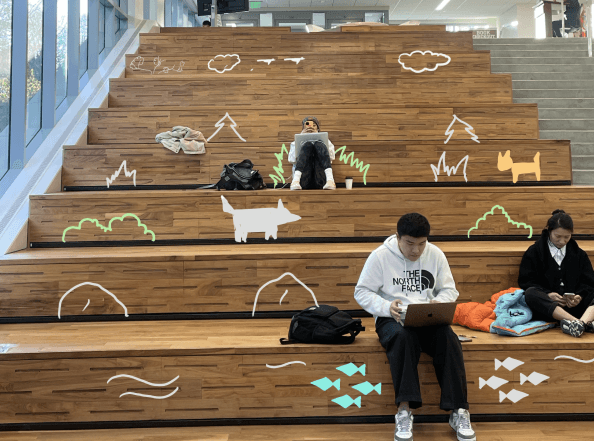
Sketching a higher fidelity after conceptual content design

Sketching a higher fidelity after conceptual content design

Sketching a higher fidelity after conceptual content design

Iteration 1: Abstract Behaviors We started with simple geometric circles. We coded collision detection and basic flocking behaviors to ensure the "creatures" felt alive before worrying about their visual fidelity.
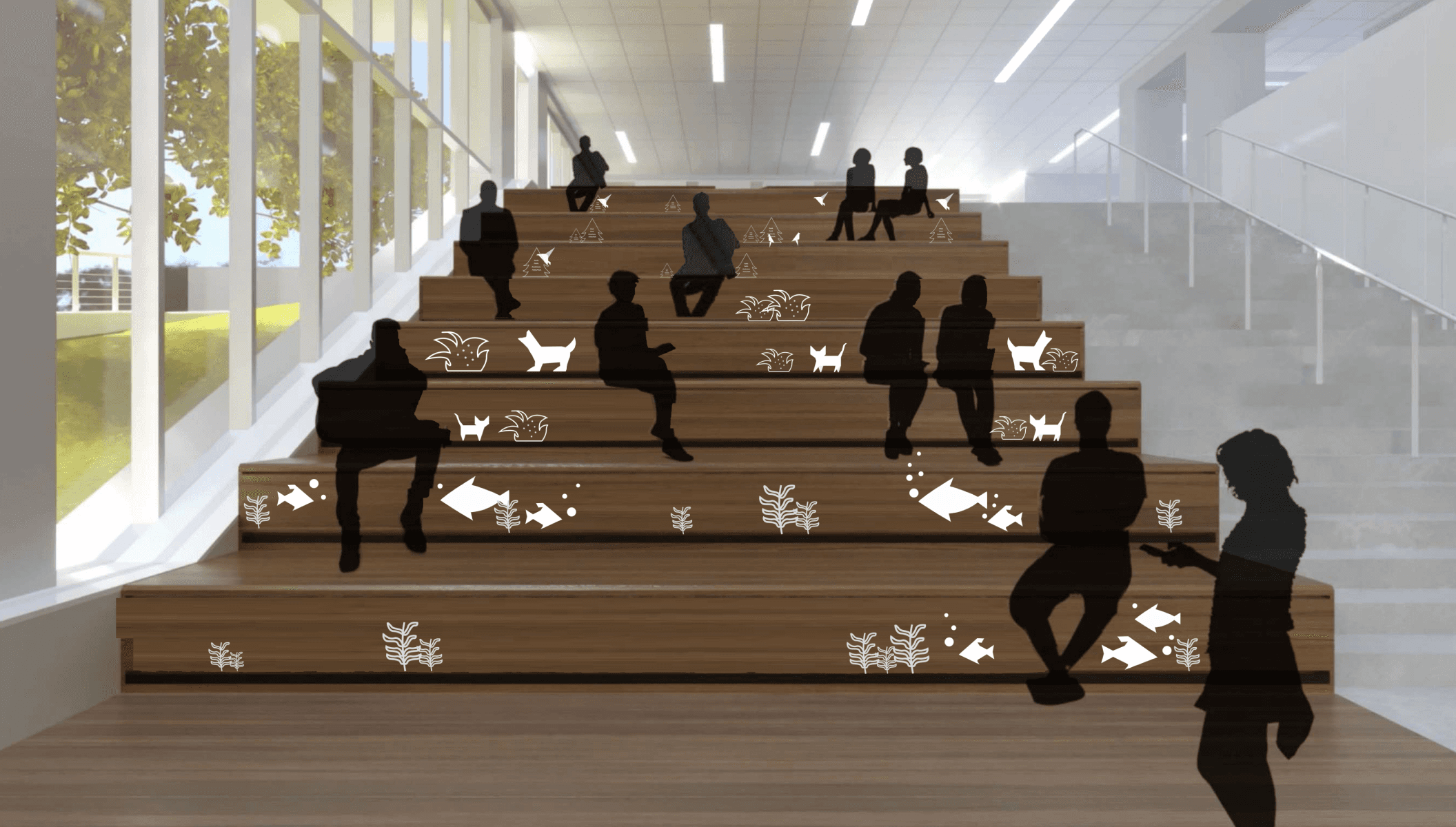

Mapping out how the journey could look like at the site

Mapping out how the journey could look like at the site

Mapping out how the journey could look like at the site

Iteration 2: Creature Definition We replaced shapes with recognizable biological forms to evoke a stronger emotional connection:

  • Dog: programmed to jump upon gesture triggers.

  • Bird: flies based on motion detection.

  • Fish: swims toward the user when they settle into the space.

Tech Stack:

  • Input: Webcam/Sensors for presence and gesture detection.

  • Processing: P5.js sketches overlayed on the video feed.

  • Output: Projectors mapped to the specific geometry of the stair risers.

Demo & Testing

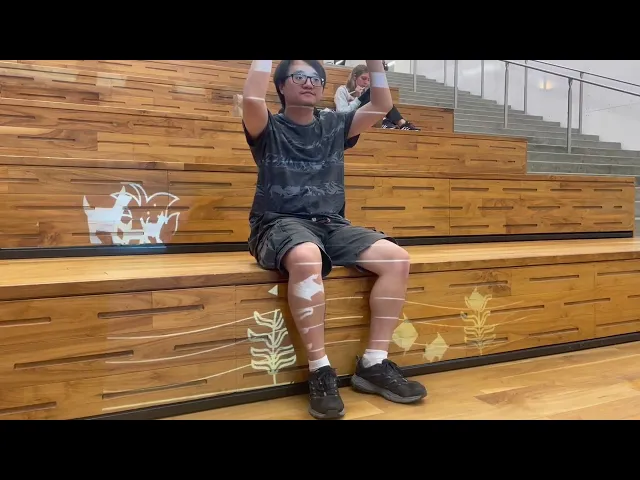
We moved from screen-based testing to in-situ testing by projecting the P5.js sketch directly onto the library stairs.


Demo & Testing

We moved from screen-based testing to in-situ testing by projecting the P5.js sketch directly onto the library stairs.


Demo & Testing

We moved from screen-based testing to in-situ testing by projecting the P5.js sketch directly onto the library stairs.


1. Fish - Swimming to the gesturer on trigger.

2.Dog  - Jumping on gesture trigger.

3. Bird -  Flying on gesture trigger.

Final Demo at the Site:
Key Findings:

  • Scale Matters: Creatures needed to be large enough to be seen from a distance but small enough to fit on a single stair riser.

  • Latency: The "delight" factor relied heavily on the responsiveness of the creature. Any lag broke the immersion.

  • Lighting: The ambient light of the library required high-contrast visuals for the projection to be legible.

Reflections

Biome AI successfully demonstrated that silent public buildings also present an opportunity for slow interactions for wellness without requiring heavy physical infrastructure.

Future Considerations:

  • Refining creature movement to avoid jarring, unnatural behaviors.

  • Community Scaling: allowing multiple students to "link" biomes, creating a shared digital garden across the staircase.

Reflections

Biome AI successfully demonstrated that silent public buildings also present an opportunity for slow interactions for wellness without requiring heavy physical infrastructure.

Future Considerations:

  • Refining creature movement to avoid jarring, unnatural behaviors.

  • Community Scaling: allowing multiple students to "link" biomes, creating a shared digital garden across the staircase.

Reflections

Biome AI successfully demonstrated that silent public buildings also present an opportunity for slow interactions for wellness without requiring heavy physical infrastructure.

Future Considerations:

  • Refining creature movement to avoid jarring, unnatural behaviors.

  • Community Scaling: allowing multiple students to "link" biomes, creating a shared digital garden across the staircase.