
Workshop held in classroom at Mary Lin Elementary
Overview
Children's knowledge of their own places can serve as the backdrop to learn about what generative AI misses.
We designed Community Futures workshop to use this context as a starting point for critical AI literacy where:
1) Children imagine futures for a creek behind their school
2) Generate images and stories with AI, then build puppets, edit scripts and perform their own alternatives.
3) Children reflect on the process, with various critique points within the design of the workshop
The contribution is an adaptable workshop framework that brings together local knowledge, tangible making and design futuring. It positions children as authors who can question, revise and negotiate AI outputs.
Problem
AI literacy often happens inside screens, a chat window, separated from the places, relationships and materials that matter to children. At the same time, generic AI narratives can smooth over local problems, disagreement and nuances. We asked two questions:
How does a familiar local environment help children recognize AI’s limitations?
How can making and performance help them work with AI-generated outputs and express their own futures?
Creek as 'Grounding"
We hosted the workshop with teachers at Mary Lin Elementary School in Atlanta.
The creek was already part of the children’s STEAM curriculum school activities and everyday experience, giving them a shared reference for judging AI outputs.
Demographics
58 students attended across two days, with a different cohort each day.
The research included 37 children with consent and assent; 31 completed both surveys.
Each workshop lasted about five hours, including breaks, with children working in groups of four or five.
Workshop Design
Part 1: Introduction and Establishing Context
We run an introduction to AI after which children documented what they knew and valued about the creek: its habitats, pollution, play, memories and community life.

Part 2: Think of Collective Futures
We encourage the children to propose a “Big Idea” for the future of the creek, children then generated good and bad news headlines from 2050. This also acts as familiarising them with the gen-AI tool and feature.
After that, kids generate their pictures of the creek based on the "Big Idea".
Part 3: Create Characters and Take Control
Within groups, each child made a puppet with a viewpoint on the imagined future: support, disagreement or mediation.
Subsequently, Groups generated a skit with the "Generate a Script" feature in MagicSchool AI, printed it.
We allowed the children to make edits: crossed out lines and rewrite dialogue they disagreed with.

Children’s Hand-On Making
Part 04: Perform and Reflect
We set up a stage where children rehearsed and then performend their revised stories.
After the performances we collectively discussed where corrections were needed and discussed what they changed, what AI missed and whose future the story represented.
The children also answer these questions individually throughout the workshop in the workbook.
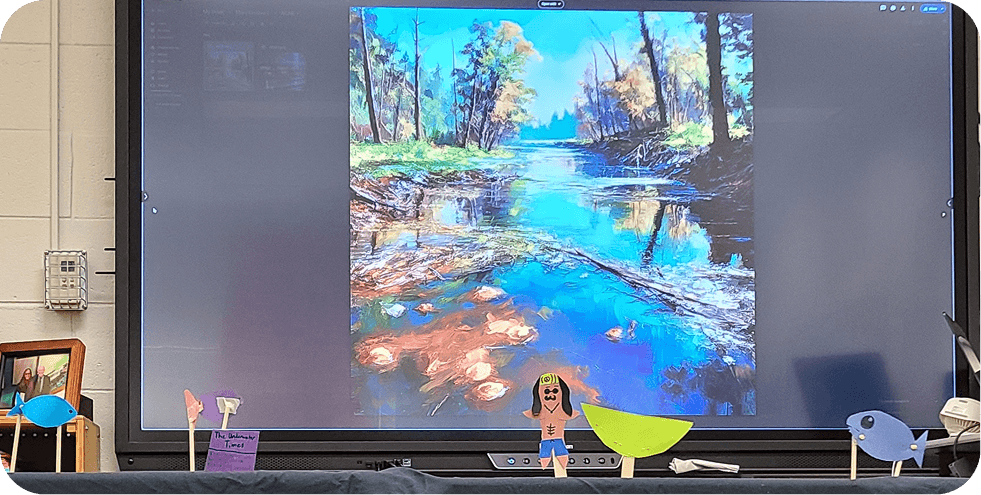
Making and Performance
Tools and Data Collection

Children using MagicSchool AI, one of the Atlanta Public School Board approved tools within their own classroom computers
The toolkit combined MagicSchool AI’s chatbot, image generator (Adobe Firefly Embedded) and skit generator with a guided Community Futures booklet, printed scripts, cardboard, felt, markers and recycled materials.
I designed workbooks and Introductory material.
The workbook included steps, paired pre/post surveys captured self-reported familiarity with AI concepts.
Analysis
Workbook data was transcribed for coding and was analyzed using Thematic Analysis. Other data included AI outputs, edited scripts, puppet photographs, field notes and audio reflections.
Two researchers initially coded the workbook data using a top-down, deductive approach, and established an equal understanding through consensus/discussion of the data to refine a shared code book.
Findings - Quantitative
Across 31 paired surveys, mean self-reported familiarity increased on a five-point scale:
a) Large Manguage Models(LLMs) from 1.87 to 3.32
b) Image Generation from 3.87 to 4.68
c) AI Bias from 2.19 to 3.42
p < .001 for all three comparisons.
These results describe perceived familiarity and self reported scores, not demonstrated learning.
The stronger finding was the children’s ability to question outputs, revise narratives and take ownership through material making and performance which was studied through qualitative data.
Findings - Qualitative
Evaluation Rooted in Local Concerns
Children evaluated generated futures against the creek behind their school. They recognized ecological damage and social realities that polished images and generic stories left out.
Their experience acted as a reference point for critique. Rather than treating the model as the authority, they could point to specific differences between its outputs and the place they knew.
Children Contested "Cheesy" Endings
16 of the 37 participants described generated narratives as “cheesy.”
Children challenged tidy resolutions and character behavior that did not fit their stories, including a group hug that made little sense for a fish puppet.
Editing and performance gave that critique a tangible output. Children removed lines, added detail and humor, and kept disagreement instead neatly resolved AI narrative proposed.

Children’s Responses
Contesting "Beautiful Images"
The default model for AI-generated creek images often looked more colourful, enchanted or pristine than the children intended. Some wanted pollution and ecological harm to remain visible in their imagined futures.
This aesthetic mismatch made the model’s limitations concrete. An appealing image still misrepresent a place.
Children critiqued this against their local knowledge to ask for less idealized, more specific representations.
Design Implications
Leverage Local Knowledge
Start with knowledge learners already hold. A familiar place creates a meaningful basis for evaluating what a model gets wrong.
Tangible Engagement for Providing Frictiopn Points
Make revision tangible. Printed scripts, physical characters and performance turn disagreement with AI into visible, collaborative action.
Futures Thinking For Scaffolding Tasks
Keep multiple possibilities open. Here, design futuring arguably allowed the children their agency in this process. Supporting conflict, uncertainty and competing ecological and social viewpoints can emerge through scaffolding the tasks with possible future scenarios.

Children’s envisioning Creek Futures as Backdrop
Reflections: AI Literacy is Hybrid & Situated
The project suggests that critical AI literacy can be hybrid (physical+digital) and situated and can be thought through local concerns.
The design opportunity is to create situations where learners can bring their own expertise into the interaction and act on their disagreement.
The study was short, based at one site and did not include a control group. Next steps include performance-based assessments, longer-term follow-up and workshops in other settings to examine learning, retention and transfer.
Acknowledgement
We Thank Mary Lin Elementary School and Ms. Carter.
Funding
a) Supported by US National Science Foundation award 2335974
b) Foundations and Applications of Generative AI award from Georgia Tech’s Institute for Data Engineering and Science (IDEaS).
Publication
Community Futures: Hybrid and Situated Critical AI Literacy. AIED 2026. Authors: Supratim Pait, Sylvia Janicki, Yuhan Hou, Michael Nitsche and Noura Howell.