Research Question
Beyond Efficiency in Creativity Support Tools
In Human-Computer Interaction (HCI), Creativity Support Tools (CSTs) are often evaluated on traditional usability metrics like efficiency, accuracy, and error reduction. However, the artistic process is inherently different—it thrives on exploration, messiness, and non-linear experimentation.
The Research Gap
We identified a need for “process-sensitive” tools that don’t just optimize the final output but engage the artist in the moment. Drawing on the concept of defamiliarization—making the familiar strange—we asked:
How might dynamic thermal feedback influence the embodied experience of painting?
Tech Probe
We developed Thermal Painting, a closed-loop system where the artist’s paint color dynamically controls the temperature of their physical environment. This system was designed not to “improve” the painting, but to invite artists into a unique, embodied interaction.
A. Interaction Design: The Color-Heat Map
The system creates a continuous feedback loop between the canvas and the body:
Warm Colors (Red/Orange/Yellow): Trigger the system to provide maximum radiant heat8.
Cool Colors (Blue/Green/Violet): Trigger the system to block the heat, creating a “cooling” sensation9.
Logic: We mapped raw hue values (0-330 Degrees) directly to the thermal intensity spectrum to allow for nuanced transitions rather than binary hot/cold states10.
B. Technical Implementation
To achieve a “real-time” sensation, we had to overcome the slow thermal inertia of standard heaters. We engineered a custom shutter system that physically regulates heat exposure.
The Brush (Input):
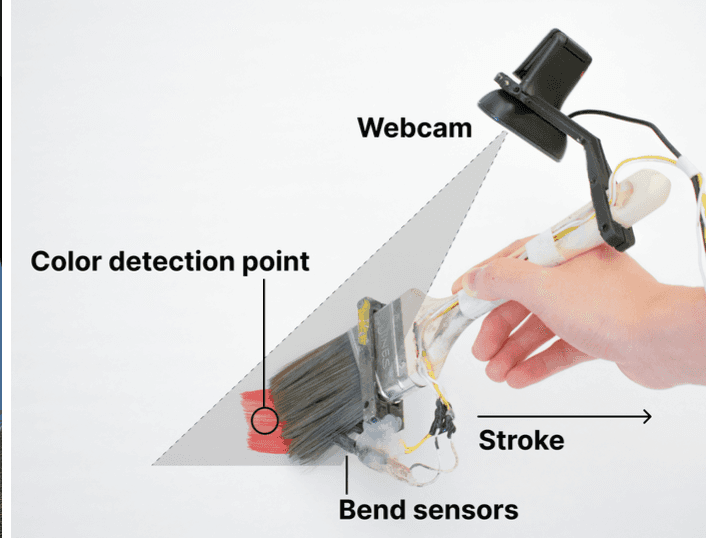
Computer Vision: A webcam mounted on the brush handle tracks the “toe” (tip) of the brush to detect color without being occluded by the artist’s hand11111111.
Bend Sensors: Two sensors embedded in the bristles detect stroke pressure and direction. The system only triggers heat when the brush is actively bending against the canvas12121212.
The Heater (Output):
Source: A Far-Infrared (IR) electric heater (CORONA DH-1220R) provides the thermal source13.
Shutter Mechanism: We built a custom frame with aluminum blinds controlled by high-speed servo motors (Futaba RS204MD).
Latency: The blinds can rotate from fully closed ($0^{\circ}$) to fully open ($90^{\circ}$) in under 0.42 seconds, making the heat feedback feel instantaneous to the user14.
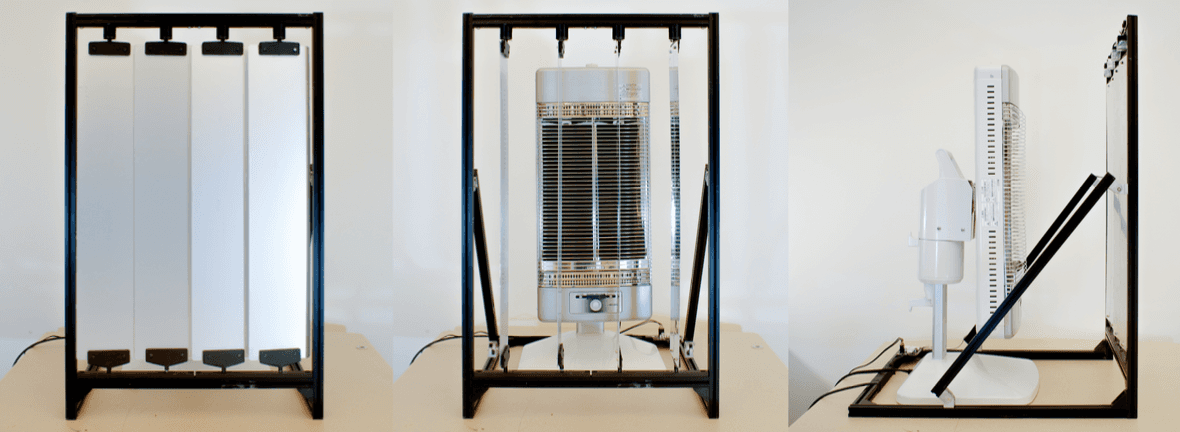
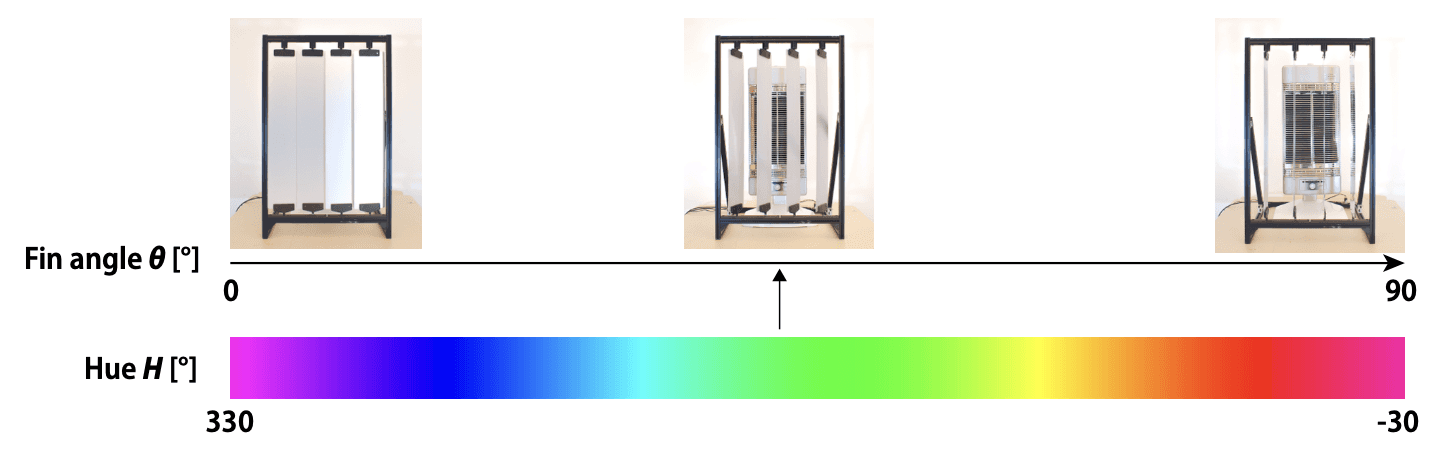
The overview of the color-heat mapping for our system. For warmer colors (e.g., red), the blinds (interchangeably called fins orshutters) are fully open, providing maximum heat. For mid-range hues such as green, the blinds are partially open, providing lessheat. For cooler colors (e.g., blue), the blinds are closed and so the artist receives no heat, which feels relatively cool because thermal perception is sensitive to change
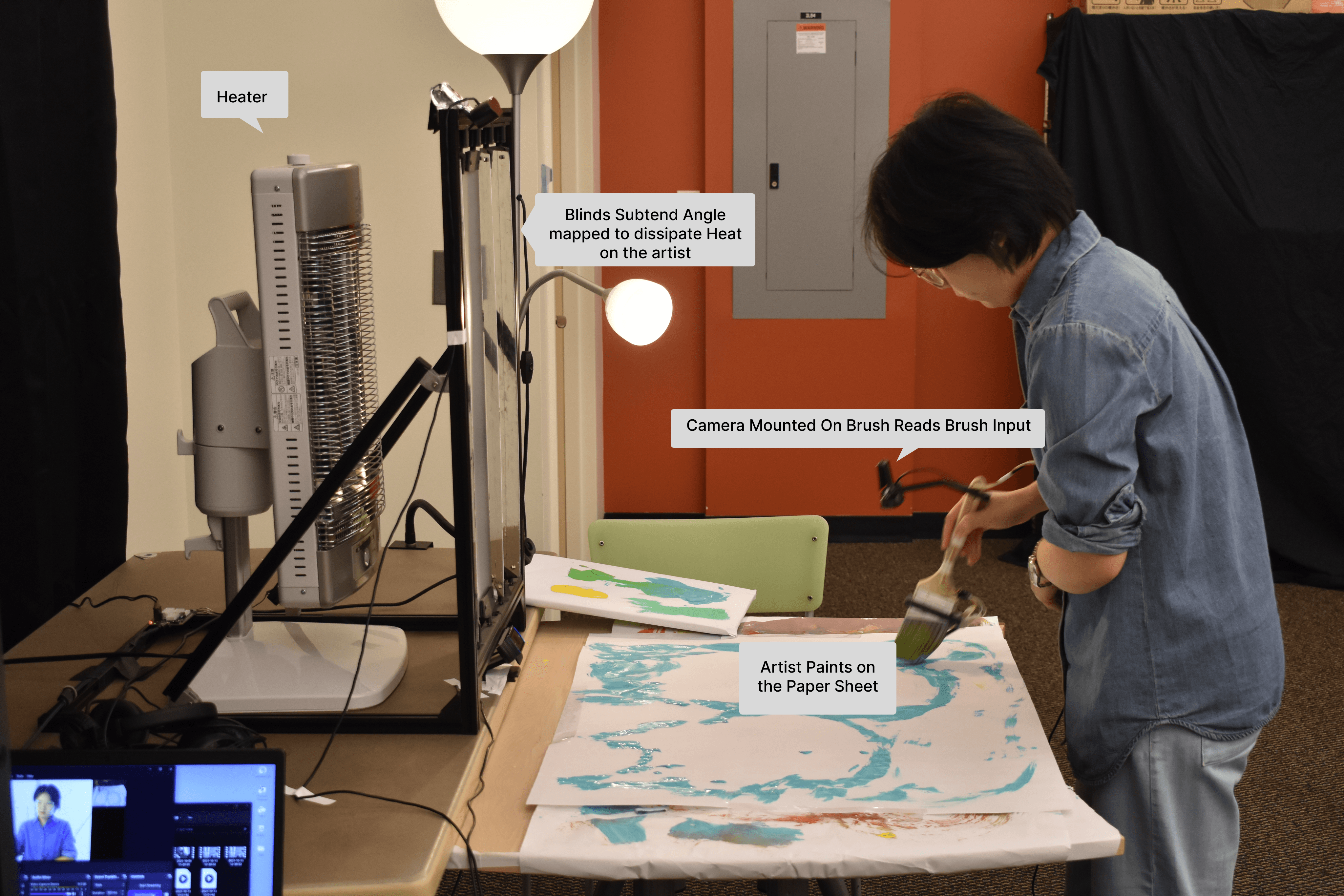
We provided dynamic environmental thermal feedback with this simple technique adapted from [40]. An infrared heater is always on. When the thermally-insulating blinds are closed (left), the heat does not reach the artist. When the blinds are open(middle), the maximum amount of heat reaches the artist. Partially opening the blinds can provide different heat levels.
User Study Design
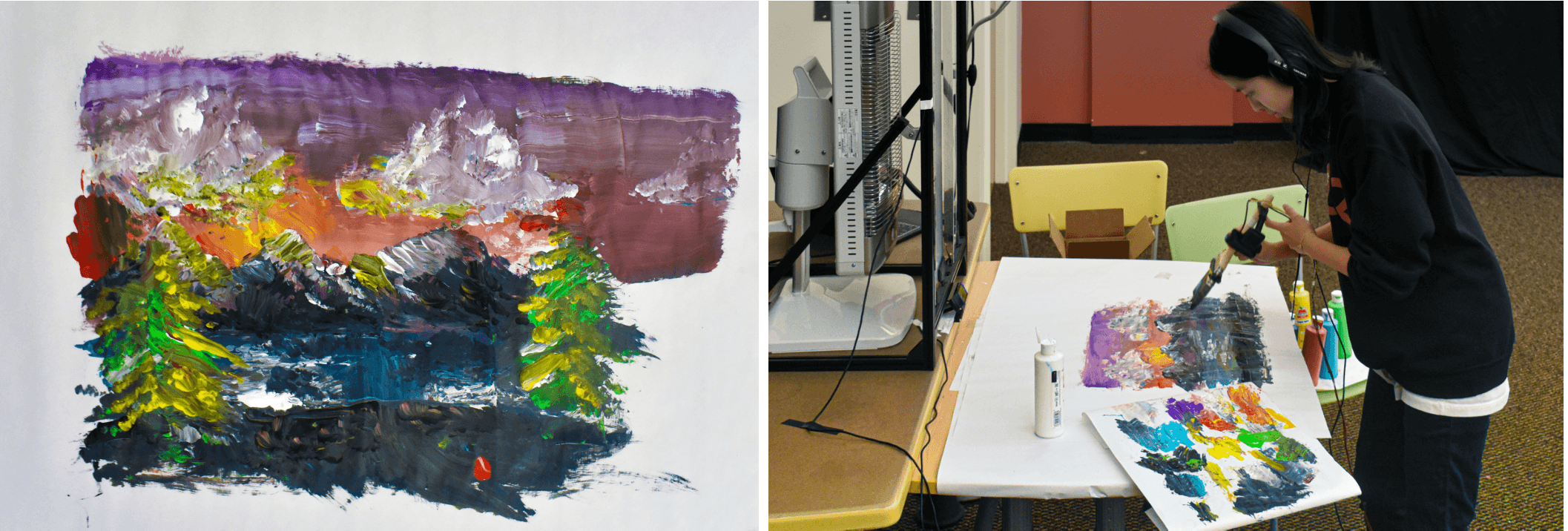
We conducted a qualitative, exploratory pilot study to capture the rich, subjective experiences of artists.
Participants: 20 artists with diverse backgrounds (Realism, Impressionism, Calligraphy, Nail Art) and experience levels ranging from <1 year to 30+ years.
Environment: A temperature-controlled room (19.9-23.1 Degree Celvius) to ensure thermal sensitivity.
Protocol:
Calibration: Calibrating the brush’s bend sensors to each artist’s stroke pressure (light vs. heavy).
Control Phase (10 min): Free painting without thermal feedback to establish a baseline18.
Experimental Phase (20 min): Free painting with dynamic thermal feedback active.
Reflection (25 min): A semi-structured interview and a “think-aloud” session where artists watched a video replay of their session to articulate their in-the-moment decision-making.
Analysis & Finding
Thematic analysis of 568 minutes of interview transcripts revealed that thermal feedback fundamentally altered the creative strategy and embodied experience of the artists.
Our thematic analysis revealed five distinct ways in which thermal feedback influenced the artists’ creative process.
Influence on Color Decisions
Thermal feedback actively steered participants’ color choices, often pushing them to expand their palette to “explore” the temperature range or restricting them to specific colors to maintain a comfortable temperature.
Palette Expansion: Participant P5 noted that the feedback caused them to use a “bigger spectrum” of colors than they initially intended, encouraging a more diverse and unpredictable output.
Structural Use: P0 utilized the feedback to make structural decisions, creating a contrast between the “cool” upper regions of a sky and the “warm” lower regions.
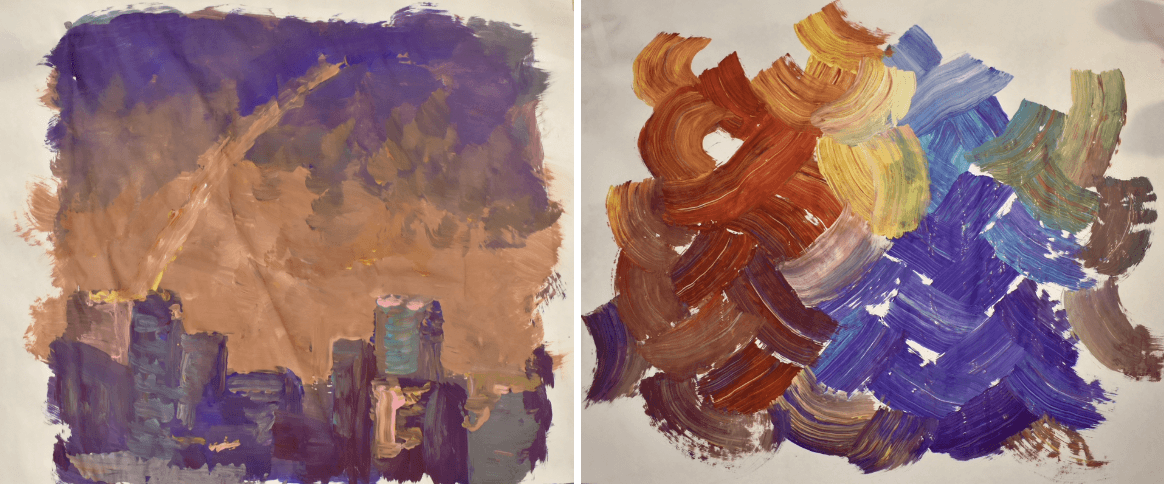
P0’s artwork (left). P0 used the thermal feedback difference to make color decisions about the contrast between the upper(cooler colors) and lower (warmer colors) sky regions. P5’s artwork (right) used an extensive, exploratory color palette and long, curvy strokes
Altered Brush Movements & Pressure
The physical sensation of heat directly impacted the motor mechanics of painting for eight participants (P1, P3, P5, P10, P11, P12, P17, P18).
Speed & Tempo: P1 reported painting “more quickly” when using warm colors. Similarly, P10 increased their brushing speed specifically to test the thermal response.
Stroke Style: P5 observed that the feedback prompted their strokes to become “curved and longer,” a distinct deviation from their usual short, straight stroke style.
Force: P11 noted that the warmth brought out the “heaviness” of the brush, leading to increased stroke pressure. P18 described using “stronger, more intense brushstrokes” because the warmth was motivating.
Comfort & Creative Flow
Several artists (P1, P5, P13) reported that the warmth facilitated a state of relaxation and immersion, often described as “flow”.
P1 described shifting from a calculated, deliberate approach to one that was intuitive and spontaneous (“trust my gut”) due to the relaxing nature of the heat.
P5 reflected that the “cozier environment” made them feel “more in my element,” helping them overcome low motivation to start an artwork.
P13 felt a heightened sense of engagement, describing the experience as “interacting with each other” (the artist and the system).
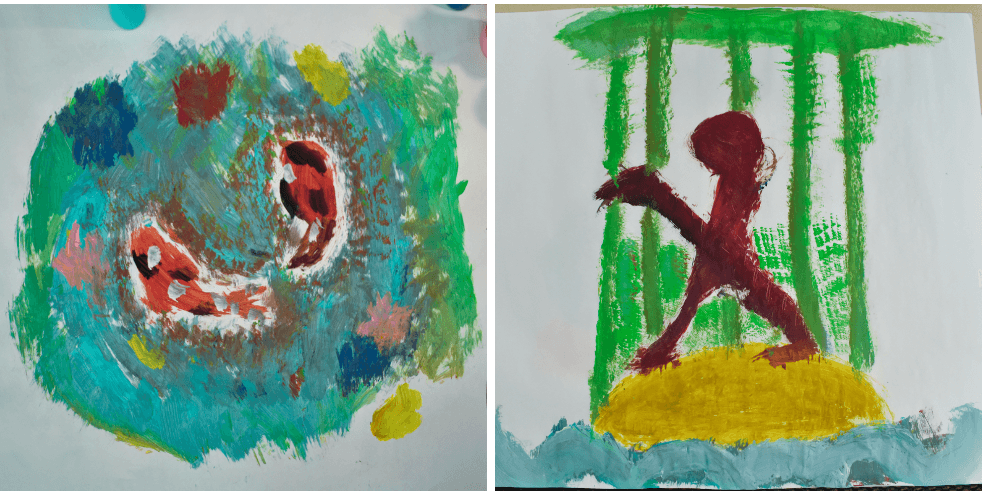
P4’s artwork (left) where they made associations between thermal feedback while painting the fish with the fish being alive.For them heat was synonymous to energy. They made sense of the lack of heat while painting the water by saying that it is water and water is “supposed” to be cool. P18’s artwork (right) during which she related the feeling of warmth from the thermal feedbackto her memories of an island upbringing as she was painting elements of water and sand.
Thematic Associations
For some artists (P4, P6, P9, P18), the temperature influenced the narrative or conceptual elements of the work.
Narrative Validation: P4 was painting a koi fish. When they used red and felt heat, they felt it validated the “aliveness” of the fish. Conversely, when painting water (blue), the lack of heat felt “correct” because water is supposed to be cool.
Environmental Logic: P6 painted a candle and, after an “energetic” start, deliberately used cool shades of green and blue to “cool down the environment”. P9 felt the heat fit the moment perfectly when painting fire.
Memory Triggers Associations
The most profound insight was the system’s ability to evoke personal memories through somatic sensation.
Cultural Nostalgia: P18 associated the warmth with their cultural roots in a Sub-Saharan African country and their upbringing in the islands.
Embodied Recall: This artist described the sensation as “the sun’s on me”. This physical feeling directly influenced their decision to paint water and sand, aligning the visual composition with their embodied memory of a warm climate.
Outliers & Exceptions
Neutral Palettes: Five artists (P7, P8, P15, P16, P19) reported no effect on their creative decisions. This was largely because they chose neutral tones that did not trigger significant thermal feedback.
Prior Knowledge: While 4 participants knew the color-heat mapping beforehand, 11 participants were influenced by the feedback without prior knowledge of how it worked
Design Implications
Beyond Optimization: Designing for Defamiliarization
While traditional Creativity Support Tools (CSTs) focus on efficiency, Thermal Painting operates as a “technology probe”—intentionally designed to make the familiar act of painting strange. By analyzing the artists’ experiences, we uncovered three critical dimensions for the future of multisensory creative tools.
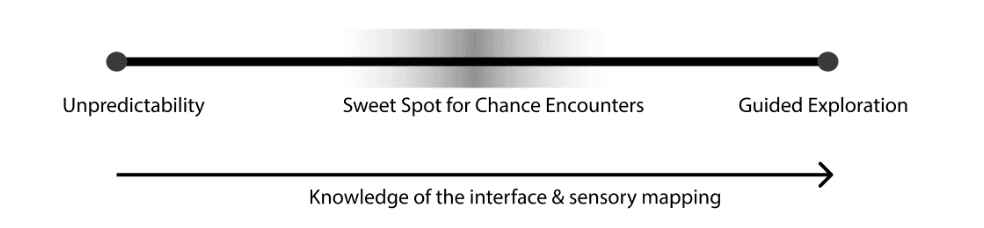
The sweet spot for designing sensory creative experiences for chance and serendipitous encounters, providing a balance between offerings of the system: unpredictability and guided exploration. The arrow represent increasing or likelihoods of chance encounters in between near the sweet spot.
The “Sweet Spot” of Chance
We found that thermal feedback introduced a productive level of “chance” into the creative process. The system was algorithmic, yet artists perceived it as a dialogue with an unpredictable partner.
Insight: There is a specific design window between complete randomness (which is frustrating) and total predictability (which is boring). Future tools should aim for this “sweet spot” where the system guides exploration without dictating the outcome.
Embodied Remembering
The most promising discovery was the link between thermal sensation and memory. Heat didn’t just change the temperature; it triggered “embodied remembering,” where physical warmth unlocked specific nostalgic memories (e.g., childhood summers, cultural landscapes) that directly influenced the artwork’s narrative.
Future Opportunity: We are investigating how sensory cues can be intentionally designed to support “serendipity”—helping artists extract meaningful insights from these unexpected memory triggers.
Creative Flow
Artists described the warmth as creating an “inward focus,” shifting their attention from the canvas to their own bodily sensations. This suggests that thermal feedback can facilitate “embodied flow”—a state of deep immersion where the mind and body act in unison.
Future Work
Forthcoming Work-in-Progress Paper at ACM Tangible, Embedded and Embodied Interaction (TEI’2026)